

Why Good Translation Still Fails
Most localization issues aren’t about incorrect translation.
They’re about tone.
When tone isn’t handled intentionally, brands usually fall into one of two traps:
the voice becomes incosistent
or it becomes so neutral that it disappears
Both are subtle, common, and they weaken the message.
Example 1: Incosistency
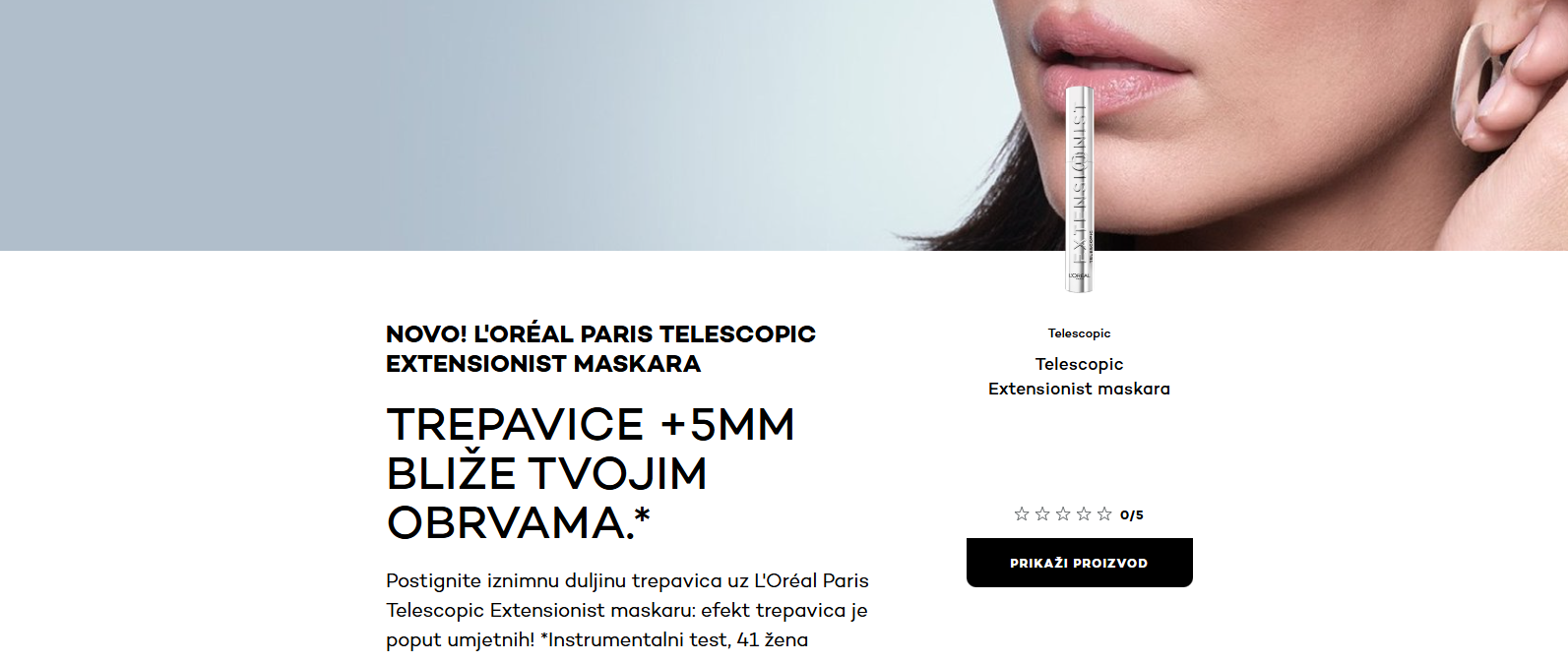
Croatian version of a page from L’Oréal
At first glance, the content of Croatian version of L’Oréal’s website looks polished. However, the tone shifts within the same screen.
“Postignite iznimnu duljinu…” → formal, brand-oriented tone (vi)
“…bliže tvojim obrvama.” → more direct, personal tone (tvojim/ti)
Each choice is valid in isolation. However, when combined, they create a mixed voice, positioned somewhere between refined and conversational.
In Croatian, this distinction is particularly significant, as pronoun choice signals level of formality, distance vs closeness, and brand positioning.
As a result, the overall tone becomes less clearly defined.
Example 2: Tone Neutralization

Croatian version of a page from Oriflame
A different pattern can be observed on the Croatian website of Oriflame.
Here, the tone remains consistent throughout the interface. The language is clear, functional, and easy to navigate, which supports usability and ensures that users can move through the site without friction.
At the same time, this consistency comes with a trade-off. Much of the wording reflects a standard e-commerce style:
“Najbolje ponude”
“Pretražite 60+kolekcija, 1000+ beauty proizvoda…”